self-service kiosks

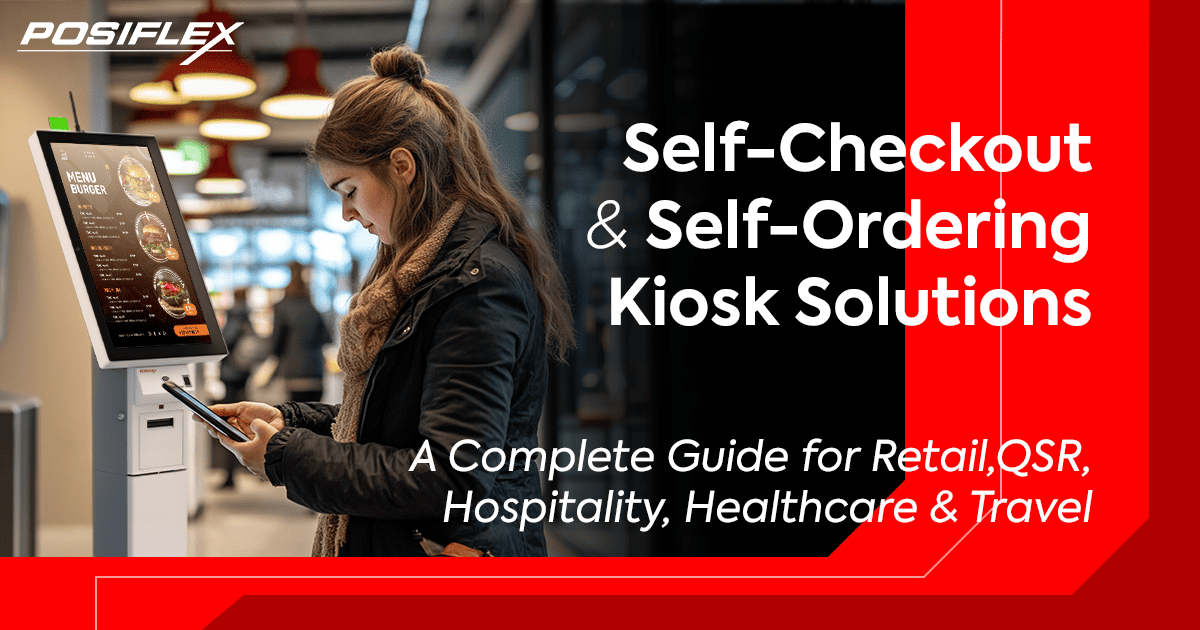
Self-Checkout & Self-Ordering Kiosk Solutions: A Complete Guide for Retail, QSR, Hospitality, Healthcare & Travel

It is a familiar scene. A grocery store on a Saturday evening. Long queues snaking past the shelves. A family with a full trolley, a professional with three items, and a student buying snacks — all stuck in the same line. Across town, a hospital registration counter has a 45-minute wait for a 10-second check-in. A hotel front desk has guests waiting because one agent is handling arrivals, ID verification, and a room issue simultaneously.  These are not just inefficiency problems. They are experience problems — and they cost businesses customers, revenue, and reputation every single day.  The answer is already here: self-checkout and self-ordering kiosk solutions in India that let customers take control of their own transactions — quickly, accurately, and on their terms. India’s self-service kiosk market is growing at over ~11% CAGR through 2030 [3], and within retail specifically, automated checkout systems for stores are expanding at a ~13.4% CAGR through 2035 [2]. The direction is clear. The question is whether your business will lead this shift — or catch up to it later.  📊 Market Insight: 61% of consumers now say they want more kiosks in restaurants — up from just over a third in 2023. This is not a trend. It is a shift in how people expect to interact with businesses. 

The 'Little Wage' Problem — India's New Labour Reality for Retailers & QSRs

The phrase “little wage” captures a challenge that is anything but little for Indian operators. Minimum wage is no longer a loose guideline in India.  

Before exploring solutions, it helps to understand the customer pain points driving this shift across every major industry. These are not abstract technology trends — they are everyday frustrations that affect real people and real businesses. 

The Customer Who Cannot Afford to Wait

Today’s consumers — particularly Millennials and Gen Z — run on speed. They order food in minutes, complete payments in a few taps, and make purchasing decisions without ever speaking to anyone. When they walk into a store, restaurant, or hospital and encounter a queue, it is not just inconvenient. It is a reason to walk away, leave a negative review, or choose a different option next time. 

self service checkout machine removes this friction entirely. Customers scan, select, and pay at their own pace — without waiting for a cashier to become available, without feeling rushed by the line behind them, and without having to repeat an order in a noisy environment. 

The 'Shyness Factor' — A Uniquely Indian Insight

Industry practitioners who work with Indian consumers consistently highlight something that rarely makes it into global kiosk research: the hesitation factor at a staffed counter. 

Many Indian customers — particularly in Tier-2 and Tier-3 cities, and especially for smaller transaction amounts — feel self-conscious at a manned counter. There is social pressure to be quick. There is awkwardness about asking questions, changing an order, or paying a specific way. On a touchscreen ordering kiosk India, that pressure disappears. The customer is in control. They can browse, customise, and pay without an audience. 

The Business Owner Who Needs More From Less

For business owners and operations managers, the challenge is not finding more staff — it is deploying existing staff more effectively. Wage costs across markets have risen steadily, and the operational cost of running multiple staffed transaction counters is increasingly difficult to justify when technology delivers a faster, more accurate result.   A self checkout machine for small business is no longer the exclusive domain of large retail chains. Hardware costs have come down substantially, and a single well-placed Posiflex kiosk can recover its investment through labour optimisation, higher transaction values, and reduced error rates within months of deployment — regardless of the size of the operation.    💡 Key Insight: Deploying a Posiflex kiosk does not mean replacing your people. It means moving your best staff away from repetitive transaction-taking and towards the roles where human presence genuinely creates value — customer care, quality control, and service recovery. 

Retail & Grocery — Faster Lanes, Bigger Baskets, Smarter Stores

Retail was the first industry to embrace self-checkout at scale and it remains the dominant application globally. From large hypermarkets to neighbourhood convenience stores, the case for a dedicated self-service kiosk for retail has never been more compelling. 

What a Posiflex Self-Service Retail Kiosk Actually Delivers

  • Customers who would have abandoned a queue now complete the purchase. Reduced wait time directly translates into fewer lost transactions — measurable in any retail format. 
  • Basket sizes increase. When customers browse without time pressure, they discover products, consider add-ons, and complete larger transactions than they would at a rushed staffed counter. 
  • Payment flexibility is built in. Posiflex kiosks function as a true contactless POS machine — accepting contactless cards, mobile wallets, and digital payment methods natively, matching how modern consumers prefer to pay. 

Posiflex SCO Series — Purpose-Built for High-Volume Retail

The Posiflex SCO (Self-Checkout) Series is available in both compact countertop and full standalone configurations, making it suitable for a neighbourhood supermarket or a large-format hypermarket. As a complete automated checkout system for stores, it integrates with the store’s existing POS and inventory software, supports multilingual interfaces, and accepts every major payment method in use today. 

A leading supermarket chain partnered with Posiflex to deploy POS terminals and SCO kiosks across multiple locations — achieving a measurable transformation in checkout throughput and a significant improvement in customer satisfaction across high-footfall store formats. 

QSR & Restaurants — Turning Rush Hours Into Revenue Hours

No sector has experienced the shift to self-service ordering as dramatically as quick-service restaurants. Consumers who are comfortable ordering everything digitally increasingly expect the same speed and control when they walk into a food outlet. A QSR self-ordering kiosk does not just reduce queue pressure — it actively improves every order placed. 

Three Things That Change When a QSR Deploys a Posiflex Kiosk

  1. Order values improve consistently. When customers browse a digital menu without time pressure, they explore options they might skip at a counter. Visual displays, combo suggestions, and customisation prompts mean customers order more — and more of what they actually want. This is informed choice, not pressure selling. 
  2.  Order accuracy improves end-to-end. A restaurant self-ordering system sends confirmed orders directly to the Kitchen Display System (KDS) — eliminating verbal miscommunication, handwriting errors, and lost order slips. In any format where the same staff member takes orders and prepares food, this accuracy improvement is immediately felt. 
  3.  Staff are freed for higher-value roles. Instead of processing dozens of identical transaction exchanges per shift, your team focuses on food quality, customer experience, and managing the dining environment — where their presence genuinely matters. 

Posiflex in QSR — Proven at Scale

A leading beverage QSR chain with over 200 outlets relies on Posiflex POS terminals to deliver fast, consistent service across every location. The reliability and low-downtime performance of Posiflex hardware is what makes it viable at multi-location scale — where a single point of failure at a busy outlet has immediate commercial consequences. 

A major corporate food service operator managing large-scale cafeteria environments across multiple sites similarly partnered with Posiflex for future-proof POS solutions capable of handling high-volume, fast-paced service reliably.

Hospitality & Hotels — When Guests Expect the Check-In to Be Effortless

The hotel industry has a longstanding paradox: guests expect warm, personalised service — but they increasingly do not want to wait in a queue to receive it. A guest who booked online, paid digitally, and navigated to the property independently arrives at the front desk expecting a frictionless experience. 

hotel self check-in kiosk resolves this without sacrificing hospitality. Guests check in, confirm their identity, select room preferences, settle any outstanding balance, and receive their room key — independently, in under two minutes, at any hour. 

What Self-Check-In Delivers for Hotel Operations

  • 24/7 check-in availability without additional staffing costs. Late arrivals and early departures are handled seamlessly. 
  • Upsell opportunities at the point of check-in — room upgrades, dining reservations, and amenity packages presented consistently, regardless of how busy the front desk is. 
  • Identity verification integrated into the kiosk flow — reducing manual data entry while supporting compliance requirements. 
  • Front-desk staff redirected to genuine hospitality work — concierge assistance, complex requests, and the personalised moments that create memorable guest experiences. 

 The Posiflex EK Series — slim, modular, and designed for public-facing environments — is equally suited to hotel lobby check-in, visitor management in mixed-use properties, and ticketing at entertainment or cultural venues.

Healthcare — Solving the Waiting Room Problem With Proven Kiosk Technology

Healthcare is where operational inefficiency carries the highest cost — not just financially, but in patient wellbeing. Long queues at registration counters delay consultations. Manual data entry introduces errors into patient records. Overloaded front-desk staff during peak hours rush interactions where accuracy matters most. 

Posiflex has directly addressed this challenge in one of healthcare’s most demanding real-world environments. When Narayana Health — one of the leading hospital networks operating across multiple facilities — needed to solve persistent operational bottlenecks in patient flow, Posiflex deployed a large-scale rollout of EK Series self-service kiosks across its facilities. The goal was clear: reduce time-to-service and improve the patient experience without adding front-desk headcount.

The Operational Challenges Posiflex Solved at Narayana Health

Before the deployment, the facilities faced challenges that are common across healthcare settings globally: 

  • Persistent long queues at patient registration counters — particularly during peak morning outpatient windows. 
  • Manual appointment scheduling across multiple departments — requiring front-desk staff to coordinate bookings in real time. 
  • Data entry errors during patient registration — manual input created inaccuracies that could affect the speed and quality of clinical care downstream. 
  • Billing complexity and cash-handling reconciliation — manual transaction management created end-of-day administrative burden. 

What Changed After the EK Series Deployment

The Posiflex EK Series kiosks — deployed as a healthcare patient check-in kiosk solution across Narayana Health facilities — enabled three core self-service functions: 
  • Patient self-registration — patients complete registration independently using the responsive touchscreen interface, significantly reducing front-desk dependency for the most routine step in the check-in process. 
  • Appointment scheduling and management — registered patients book, reschedule, or cancel appointments across departments directly at the kiosk. 
  • Digital queue management — patients receive a digital token confirming their queue position, reducing waiting-room uncertainty and improving the overall experience. 
The impact was captured directly in the words of Narayana Health’s own leadership:  Implementing POSIFLEX’s kiosks saved us several man-hours and helped execute multiple processes more accurately.   — Key decision-maker, Narayana Health management   On the experience of transitioning from manual to kiosk-based check-in:  “Transitioning from the manned-desk patient registration process to self-check-in was a breeze due to the responsive touchscreens and low-downtime hardware of the kiosks.”  — Senior stakeholder, Narayana Health  Beyond the direct time savings, the kiosk deployment also increased the likelihood of patients completing transactions digitally — naturally reducing cash handling, billing disputes, and administrative reconciliation effort. Source: Posiflex — Narayana Health Case Study [7]  📌 Healthcare Insight: The operational challenges Narayana Health faced are not unique to one facility or one region — they are the standard reality of high-volume healthcare environments globally. The Posiflex EK Series offers a proven, scalable path to address them. 

Travel & Transportation — Serving High-Volume Passengers at Speed

Airports, train stations, and transit hubs are among the most demanding real-world environments for any customer-facing technology. Peak traffic, time-pressured passengers, multilingual requirements, and the need for near-zero downtime converge in a single operational setting. 

An airport self-service kiosk in these environments is not a convenience upgrade — it is an operational necessity. Staffed service points simply cannot scale to the volume of passengers moving through modern transit infrastructure.

Where Self-Service Kiosks Make an Impact in Travel & Transit

  • Flight check-in and boarding pass issuance — enabling passengers to complete check-in independently, reducing counter pressure during peak departure windows. 
  • Transit ticketing at stations and hubs — metro networks, rail terminals, and bus interchanges use self-service ticketing to handle daily commuter volumes that would be unmanageable through staffed booths alone. 
  • Food ordering at airport dining outlets — time-pressured travellers are ideal users of self-ordering kiosks: they want speed, accuracy, and the ability to pay and collect without waiting for counter service. 
  • Wayfinding and visitor information — interactive kiosks guide passengers through complex terminals, multi-building facilities, and large public spaces without requiring staff at every decision point. 

The Posiflex EK Series — with its slim profile, modular configuration, and compact footprint — is designed for these constrained, high-footfall public environments. It handles ticketing, payment, and wayfinding in a single, configurable unit that can be deployed and updated remotely. 

A Practical Guide to Getting Your Kiosk Deployment Right

  • Start at your highest-pain touchpoint. Where does your longest queue form? Where does your team feel most stretched at peak hours? Deploy your first kiosk there. Visible ROI at the first location builds confidence — internally and with stakeholders — for a wider rollout. 
  •  
  • Match the payment methods your customers use. Any self-service deployment must support the payment methods your customers already use. Configure your Posiflex kiosk to accept contactless cards, mobile wallets, and any locally dominant payment method from day one. 
  •  
  • Localise the language and interface. Work with your Posiflex implementation team to configure the interface in the language — or languages — your customers are most comfortable with. A single localisation decision significantly improves adoption in diverse or multilingual markets. 
  •  
  • Integrate with your existing systems. A Posiflex kiosk connected to your POS, inventory, loyalty programme, and kitchen systems is far more valuable than a standalone terminal. Posiflex’s open architecture supports integration with most existing retail and hospitality software. 
  •  
  • Train staff as kiosk guides, not bystanders. In the first few weeks of deployment, have a team member available to help hesitant first-time users. Self-adoption accelerates quickly once customers experience the speed for themselves. Frame this to your team as a service enhancement, not a competitive threat. 
  •  
  • Use the data your kiosk generates. Every transaction is a data point. Peak ordering times, popular products, average transaction values, payment method preferences — these insights are available in real time and can improve decisions that a staffed counter simply cannot support.

Which Posiflex Solution Is Right for Your Business?

Sector 

Typical Use Case 

Posiflex Solution 

Key Capability 

Grocery / Supermarket 

Hypermarkets, supermarkets, convenience stores 

SCO Series (countertop / standalone) 

AI object recognition + contactless payment + loss prevention 

QSR / Food Service 

Quick-service restaurants, food courts, cafeterias 

SOK (Self-Ordering Kiosk) + KDS 

Digital ordering + kitchen integration + upsell prompts 

Hotel / Hospitality 

Business hotels, resorts, serviced apartments 

EK Series + MT-6200 Tablet 

Self check-in, ID verification, contactless payment 

Healthcare / Hospital 

Hospital networks, clinic chains, diagnostics 

EK Series (as deployed at Narayana Health) 

Patient registration, queue management, appointment booking 

Airport / Transit Hub 

Airports, train stations, metro networks 

EK Series Ticketing Kiosk 

Ticketing, wayfinding, boarding pass issuance 

Small Business / SMB 

Cafés, boutique retail, clinics, salons 

SCO Countertop / Concept Kiosk 

Compact, affordable, automated checkout 

Conclusion — The Self-Service Window Is Open. Right Now.

The factors driving kiosk adoption have never been more aligned. Consumers expect faster, more autonomous service experiences. Operational costs are rising in every market. And the technology — proven in hospitals, QSR chains, transit networks, and retail environments — delivers measurable results. 

Whether you are a supermarket manager looking to replace your peak-hour queue with a smooth self service checkout machine, a hospital administrator wanting to solve registration bottlenecks the way Narayana Health did, or an SMB owner exploring what a self checkout machine for small business could do for a busy service period — the question is not whether to move. It is how fast. 

Posiflex brings four decades of global POS hardware expertise, AI-powered kiosk technology, and proven deployments across retail, QSR, healthcare, hospitality, and travel. Every business that has made this transition has discovered the same thing: the investment in a Posiflex self-checkout kiosk pays for itself quickly — and the improvements in customer experience, staff focus, and operational efficiency compound over time. 

Ready to see how a Posiflex automated checkout system for stores or self-ordering kiosk can work in your specific environment? Contact Posiflex today to book a free consultation and product demonstration. 

Frequently Asked Questions (FAQ)

self service checkout machine is an interactive touchscreen terminal that allows customers to scan items, review their selection, and pay — without a cashier. Modern systems like the Posiflex SCO Series connect directly to the store's POS and inventory platform in real time. They accept contactless cards, mobile wallets, and digital payment methods, and advanced models use AI cameras and object recognition to identify items without barcodes — covering fresh produce, loose goods, and unpackaged items common in grocery and food retail. 

A contactless POS machine processes payments without physical card insertion — using NFC (tap-to-pay) or mobile wallet technology. As consumer payment behaviour shifts rapidly towards contactless methods, a kiosk or POS terminal without contactless capability creates unnecessary friction at the point of sale. Posiflex kiosks and POS terminals support all contactless payment methods natively, ensuring the checkout experience matches how today's customers prefer to pay. 

Yes. The perception that automated checkout systems are only viable for large retail chains no longer reflects reality. Posiflex offers compact countertop kiosk configurations that are well-suited to cafés, neighbourhood grocery stores, pharmacies, and salons. A self checkout machine for small business reduces counter staffing pressure during peak periods, accelerates transaction times, and delivers a more professional customer experience — at a hardware investment that delivers ROI within months for businesses with moderate daily footfall. 

Posiflex deployed EK Series self-service kiosks across Narayana Health facilities to address long OPD registration queues, manual appointment scheduling, and data entry errors. The kiosks enabled patients to self-register, book or reschedule appointments, and receive a digital queue token — all independently. Narayana Health's management confirmed the deployment 'saved several man-hours and helped execute multiple processes more accurately,' and described the transition to self-check-in as 'a breeze due to the responsive touchscreens and low-downtime hardware.' The deployment also increased digital transaction completion, reducing cash-handling and billing disputes. [7] 

A QSR self-ordering kiosk automates the order-taking function, allowing operators to redeploy counter staff to food preparation and customer service. Beyond cost optimisation, kiosks improve order accuracy by routing confirmed orders directly to the kitchen — eliminating verbal miscommunication and errors. They also consistently increase average transaction values because customers browse digital menus at their own pace, discovering items and customisation options they might skip at a staffed counter under time pressure. 

Posiflex kiosks support the full range of modern payment methods: contactless card payments via NFC, mobile wallets, QR code-based digital payments, chip-and-PIN card payments, and where applicable, cash-handling for hybrid models. The platform is configurable to the payment infrastructure of the specific market and retail environment in which it is deployed. 

Posiflex kiosks support the full range of modern payment methods: contactless card payments via NFC, mobile wallets, QR code-based digital payments, chip-and-PIN card payments, and where applicable, cash-handling for hybrid models. The platform is configurable to the payment infrastructure of the specific market and retail environment in which it is deployed. 

Yes. Posiflex kiosk configurations for hospitality include optional ID scanning and verification modules, supporting the compliance requirements of hotel check-in processes across markets. Guests can complete the full check-in flow — booking confirmation, ID verification, room selection, payment, and key issuance — without visiting the front desk. This is available around the clock, which is particularly valuable for late-night arrivals and properties with high occupancy during peak travel periods. 

Yes. Posiflex kiosks are built on an open architecture that supports integration with leading POS systems, kitchen display systems (KDS), loyalty programmes, inventory management platforms, and payment gateways. The Posiflex implementation team manages the integration from initial pilot to full-scale deployment, ensuring the kiosk works within the existing technology ecosystem rather than alongside it as a disconnected device. 

Posiflex combines 40+ years of POS hardware manufacturing expertise with production-ready AI capabilities — including AI object recognition, voice command interaction, intelligent loss prevention, and cloud-based remote management. Unlike software-first vendors that source commodity hardware, Posiflex designs and manufactures purpose-built solutions for each vertical. The Posiflex Group — which includes Posiflex (POS & Kiosk), Portwell (AIoT edge compute), and KIOSK Information Systems (managed self-service automation) — offers an end-to-end intelligent platform. Real-world deployments across healthcare, QSR, retail, and transit environments, including the Narayana Health EK Series rollout, demonstrate that Posiflex solutions deliver measurable outcomes at scale. 

Here are the requirements you need to fulfill.
Skilled Manpower
Storage & Servicing Area
GST or Trade Licence
Here are the requirements you need to fulfill.
Skilled Manpower
Storage & Servicing Area
GST or Trade Licence
Please fill the details below