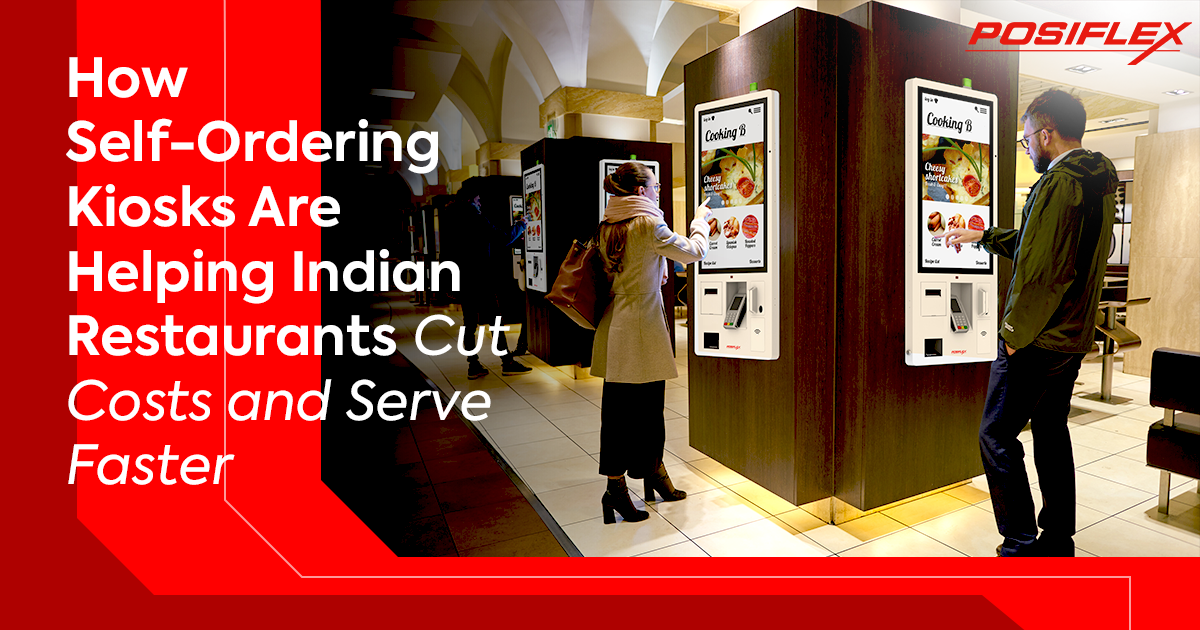
How Self-Ordering Kiosks Are Helping Indian Restaurants Cut Costs and Serve Faster
If you’ve walked into a modern food court, a highway diner, or a mall QSR outlet lately, you’ve probably noticed it — a sleek touchscreen standing at the counter, letting customers browse the menu, place their order, and pay, all without waiting for a cashier.
That’s a self-ordering kiosk. And it’s no longer just a feature reserved for global fast-food giants.
Across India, quick service restaurants (QSR), food courts, cloud kitchen pickup counters, and standalone eateries are adopting self-service kiosk technology — not just to look modern, but because the business case is undeniable.
In this blog, we break down what self-ordering kiosks actually do, why Indian restaurants are making the switch, what to look for when choosing one, and how Posiflex India’s kiosk solutions help you get there.
What Is a Self-Ordering Kiosk?
A self-ordering kiosk is a touchscreen terminal placed at or near your counter that allows customers to:
Browse your full menu with images, descriptions, and add-on options
Customize their order — size, toppings, spice level, dietary preference
Pay directly via UPI, card, or cash
Receive a token or printed order slip
The order goes directly to the kitchen display or POS system. No miscommunication. No queue. No dependency on a single cashier handling everything at once.
It sounds straightforward — but the operational impact it creates is anything but small.
The Real Problem Happening at Your Counter Right Now
Let’s be direct about what peak-hour looks like at most Indian QSR outlets:
A queue builds fast. One or two cashiers are simultaneously taking orders, processing payments, answering questions, and managing complaints. Orders get mixed up. Customers leave before ordering. Upselling is impossible when staff are just trying to keep up.
And then there’s staff turnover — one of the biggest operational headaches in the food service industry. Every time a new employee joins, you’re spending days training them on your menu, your POS, your workflow.
This is the everyday reality for restaurant owners across India. And as dining footfall grows — in malls, IT parks, airports, and highways — the cracks in a purely cashier-driven model start to show up in your revenue.
The answer isn’t always hiring more people. Sometimes, it’s rethinking the counter itself.
Why Indian QSRs Are Moving to Self-Ordering Kiosks
Faster Service, Happier Customers
A self-service ordering kiosk processes one customer while your staff preps the previous order. Two or three kiosks running simultaneously can handle the kind of crowd that would otherwise require four to five cashiers. Customers spend less time waiting, and that directly improves their experience — and their likelihood of coming back.
Average Order Value Goes Up
This is one of the most underrated benefits. When a customer is ordering on a screen at their own pace — with images, combo suggestions, and add-on prompts visible — they tend to spend more. There’s no social pressure, no rush, and the screen is designed to suggest relevant upsells naturally. Restaurants using kiosk-based ordering consistently report a meaningful lift in average ticket size.
Reduced Cashier Dependency and Training Time
With a self-service kiosk handling order-taking and payment, your counter staff can focus on what actually matters — food preparation, delivery, and customer service. New hires don’t need to memorize every combo on day one. The kiosk does that job.
Fewer Errors, Better Accuracy
Verbal miscommunication is one of the leading causes of wrong orders in restaurants. When a customer inputs their own order on a touchscreen kiosk, what goes to the kitchen is exactly what they asked for. Fewer remakes. Less food waste. Fewer frustrated customers.
24/7 Readiness Without Extra Staffing
Whether it’s a late-night crowd at a highway dhaba or an early morning rush at an airport outlet, a self-ordering kiosk is always ready. No shift gaps, no sick leaves, no training lags. Your counter works even when your team is stretched thin.
What to Look for in a Self-Ordering Kiosk for Your Restaurant
Not all kiosks are built the same. When evaluating a self-service kiosk solution for your QSR or food court, here’s what matters:
Screen Size and Placement Flexibility
Your kiosk should fit your space. A compact countertop kiosk works well for smaller outlets, while a floor-stand kiosk suits high-footfall environments where visibility and accessibility are key. Look for options that offer both.
Posiflex’s JK Series Self-Service Kiosk is available in multiple form factors — countertop and floor-stand — with screen sizes ranging from 15″ to 32″, making it adaptable for everything from a small QSR counter to a large food court deployment.
POS Integration
A kiosk that doesn’t talk to your existing POS system creates more problems than it solves. Ensure the solution you choose supports seamless integration with your current billing and kitchen display setup. Posiflex kiosks are designed for smooth POS interoperability, so your existing workflow doesn’t need a complete overhaul.
Payment Flexibility
Indian customers pay in multiple ways — UPI, debit/credit card, wallets, and cash. Your self-ordering kiosk must support all of these. A kiosk that only accepts cards will frustrate a large chunk of your walk-in customers.
Durability for High-Traffic Use
A restaurant counter is a demanding environment. Grease, spills, constant touching, high temperatures — your kiosk hardware needs to be built to handle it. Posiflex kiosks are engineered for commercial-grade durability, built to stay reliable in exactly these conditions.
Support and Serviceability
This is often overlooked. When something breaks, how fast can you get it fixed? Posiflex India operates a service network across 450+ locations in India, ensuring that your kiosk downtime is minimal and support is always accessible.
Which Posiflex Kiosk Is Right for Your Restaurant?
Here’s a quick guide:
For QSRs, food courts, and casual dining with moderate to high footfall: The JK Series offers large display options, flexible mounting, and robust performance — ideal for self-ordering in fast-paced environments.
For compact outlets, cloud kitchen pickup points, or countertop deployment: The EK Series is a space-efficient solution that delivers full self-service capability in a smaller footprint — perfect when counter space is limited.
For hotels, resorts, or hospitality-focused F&B operations: The HK Series is purpose-built for hospitality settings, combining check-in/checkout capability with a modular design that integrates beautifully into hotel restaurant environments.
Is a Self-Ordering Kiosk Right for Your Business?
If your restaurant experiences any of the following, the answer is almost certainly yes:
Peak-hour queues that slow down service
High cashier turnover or training overhead
Frequent order errors or miscommunication
A desire to increase average order value without adding staff
Plans to scale to multiple locations
Self-service kiosk technology isn’t just for big chains. It’s now accessible, affordable, and purpose-built for the Indian market — and Posiflex India is at the forefront of that shift.
A self-ordering kiosk is a touchscreen self-service terminal that allows restaurant customers to browse a menu, place an order, and make payment independently — without cashier assistance.
By handling order-taking and payment processing, a kiosk reduces dependency on counter staff, lowers training costs, and minimizes order errors — all of which directly impact operational expenses.
Absolutely. Posiflex offers countertop kiosk options like the EK Series that are compact, affordable, and ideal for smaller QSR outlets or cloud kitchen pickup points.
Posiflex kiosks support multiple payment modes including UPI, debit/credit cards, digital wallets, and cash — covering the full range of how Indian customers pay.
Final Thought
The Indian restaurant industry is evolving fast. Customers expect speed, accuracy, and convenience — and the businesses that deliver on all three will pull ahead of those still relying on a single cashier at a crowded counter.
A self-ordering kiosk isn’t a replacement for your team. It’s what frees your team to do what they do best — cook great food and take care of your customers.